
Introduction
Cyber insurance requirements have changed significantly.
In 2026, it’s no longer enough to simply apply for coverage—you must prove your cybersecurity controls are in place and enforced.
For financial firms, this means:
👉 If you can’t demonstrate strong security practices, you may face higher premiums, limited coverage, or even denied claims.
Why Cyber Insurance Requirements Have Tightened
Cyber insurance providers have paid out billions in claims over the past several years.
The result?
👉 They’ve shifted from trusting applicants to verifying controls.
What This Means for Financial Firms
Insurance companies now expect firms to:
- Reduce risk proactively
- Implement proven security controls
- Provide evidence of enforcement
Cyber insurance is no longer just a safety net—it’s a security validation process.
The Most Common Cyber Insurance Requirements in 2026
While requirements vary by provider, most financial firms are expected to have the following controls in place:
- Multi-Factor Authentication (MFA)
Required for:
- Email accounts
- Remote access
- Administrative users
- Endpoint Detection & Response (EDR)
Monitoring and response capabilities across all devices
- Secure, Tested Backups
- Regular backups
- Offsite or immutable storage
- Proven ability to restore
- Email Security Protections
Advanced filtering and phishing protection
- Access Control Policies
- Least privilege access
- User access reviews
- Written Security Policies (WISP)
Documented and enforceable security framework
- Security Awareness Training
Ongoing employee education and phishing simulations
- Incident Response Plan
Documented process for handling security incidents
These are no longer “best practices”—they are baseline expectations.
What Most Financial Firms Get Wrong
Many firms assume:
👉 “We have insurance, so we’re covered.”
But here’s what actually happens:
❌ Misrepresenting Security Controls
Applications often ask:
- “Do you enforce MFA?”
- “Do you have monitoring in place?”
If the answer is inaccurate:
👉 Claims can be denied.
❌ Incomplete or Inconsistent Implementation
Having a control partially implemented (e.g., MFA for some users) may not meet requirements.
❌ Lack of Proof
Even if controls exist:
If you can’t demonstrate them, they may not count.
What Happens If You Don’t Meet Requirements
If your firm doesn’t meet current expectations, you may experience:
⚠️ Higher Premiums
Insurance providers price based on risk
⚠️ Coverage Limitations
Certain incidents may be excluded
⚠️ Denied Claims
Especially if controls were misrepresented or not enforced
⚠️ Difficulty Obtaining Coverage
Some firms are now uninsurable without baseline controls
What “Insurance-Ready” Looks Like in 2026
A financial firm that is prepared for cyber insurance can:
✅ Demonstrate Control Enforcement
Security measures are applied consistently across the organization
✅ Provide Documentation
Policies and procedures are clearly defined
✅ Show Evidence
Logs, reports, and monitoring data are available
✅ Respond Confidently to Questionnaires
No guesswork—clear, accurate answers
Insurance-ready firms don’t just check boxes—they can back them up.
How to Prepare for Cyber Insurance Requirements
If your firm wants to improve its position:
- Assess Your Current Controls
Identify gaps in your security posture
- Enforce Consistency
Apply controls across all users and systems
- Document Everything
Policies, procedures, and configurations must be recorded
- Implement Monitoring
Ensure visibility into threats and activity
- Validate Your Answers
Make sure insurance applications reflect reality
Who This Applies To
This applies directly to:
- Financial advisors
- CPA firms
- Wealth management firms
- Tax and bookkeeping firms
If your firm carries cyber insurance—or plans to—you will be evaluated.
Download the Full Guide
Cyber insurance requirements are built around having the right controls in place.
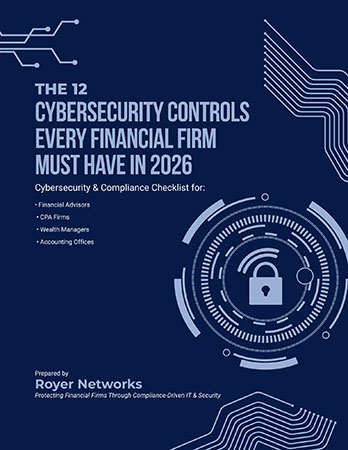
👉 Download: “12 Cybersecurity Controls Every Financial Firm Must Have in 2026”
Inside, you’ll get:
- A full checklist
- Common gaps we see in financial firms
- A simple way to assess your current risk
🔚 Closing Thought
Cyber insurance doesn’t replace cybersecurity.
It validates it.
If you can’t prove your controls, you may find out the hard way—when it matters most.