
Introduction
Most financial firms believe they have cybersecurity “covered.”
But when we take a closer look…
👉 The same gaps show up again and again.
Not because firms don’t care—but because cybersecurity today isn’t just about tools.
It’s about controls, enforcement, and proof.
And that’s where things break down.
Why These Gaps Exist
Financial firms often invest in:
- Antivirus
- Firewalls
- IT support
But what’s missing is:
- Documentation
- Consistency
- Monitoring
- Accountability
The result: A false sense of security.
The 7 Most Common Cybersecurity Gaps
These are the gaps we see most often in financial firms:
- Weak or Inconsistent MFA
MFA may exist—but it’s often:
- Not enforced for all users
- Not applied to email
- Using weak methods (like SMS)
👉 Fix: Enforce MFA across all users, systems, and access points using strong authentication methods.
- No Written Information Security Plan (WISP)
Many firms either:
- Don’t have one
- Or rely on a generic template
👉 Fix: Create a customized, actively maintained WISP tied to your actual environment.
- Lack of Endpoint Monitoring (No EDR)
Firms rely on antivirus without:
- Behavioral detection
- Real-time response
👉 Fix: Deploy EDR across all devices with monitoring and response capabilities.
- Over-Reliance on Email Filtering
Firms assume filtering alone is enough.
But modern attacks:
- Bypass filters
- Target users directly
👉 Fix: Layer email security with MFA, user training, and verification policies.
- No Ongoing Security Awareness Training
Employees are often untrained on:
- Phishing recognition
- Social engineering tactics
👉 Fix: Implement regular training and simulated phishing exercises.
- Poor Access Control (Too Much Access)
Users often have:
- More access than needed
- No regular access reviews
👉 Fix: Apply least privilege principles and review access regularly.
- No Monitoring or Reporting
Firms cannot:
- Detect suspicious behavior
- Provide logs or audit trails
👉 Fix: Implement centralized monitoring and maintain reporting capabilities.
The Biggest Problem: These Gaps Don’t Exist Alone
Most firms don’t have just one gap.
They have several.
And when combined, these gaps create:
👉 Increased risk of breach
👉 Failed audits
👉 Cyber insurance issues
It’s not one weakness—it’s the combination that creates exposure.
What “Secure” Actually Looks Like
A well-protected financial firm doesn’t rely on a single tool.
It has:
✅ Enforced Security Controls
Applied consistently across users and systems
✅ Documented Policies
Clear, current, and aligned with operations
✅ Monitoring & Visibility
Real-time awareness of activity and threats
✅ Accountability
Defined ownership of cybersecurity
Security isn’t about having tools—it’s about having control.
How to Identify Your Gaps
Start with a simple question:
👉 Could you prove your security controls are in place today?
If the answer is unclear, you likely have gaps.
Next Steps:
- Conduct a gap assessment
- Prioritize critical controls
- Document and enforce policies
- Implement monitoring
- Review regularly
Who This Applies To
This applies directly to:
- Financial advisors
- CPA firms
- Wealth management firms
- Tax and bookkeeping firms
If your firm handles financial data, these gaps are relevant to you.
Download the Full Guide
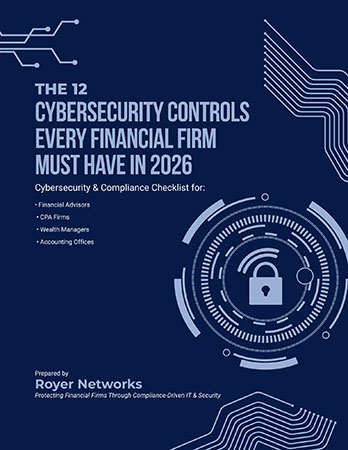
These gaps are exactly what the 12 cybersecurity controls are designed to address.
👉 Download: “12 Cybersecurity Controls Every Financial Firm Must Have in 2026”
Inside, you’ll get:
- A full checklist
- A breakdown of each control
- A simple way to assess your current risk
🔚 Closing Thought
Most breaches don’t happen because of one big failure.
They happen because of small gaps left unaddressed.
The firms that stay secure are the ones that close those gaps—before someone else finds them.